
Service / Statewide NC
Land Clearing for North Carolina Lots, Pastures and Homesites
When a piece of ground needs to go from woods or overgrowth to something you can build on, graze, or drive across, land clearing is the first real step. We take out what is in the way and leave the ground ready for what comes next.
What land clearing actually includes
Land clearing is a broad phrase, so we pin it down before any machine shows up. On most jobs it means cutting standing trees, removing or grinding stumps, clearing the brush and vines underneath, and dealing with the resulting debris so the ground is open and usable. Depending on the plan, it can also include a rough grade so water runs the right way and the surface is ready for a builder, a fence crew, or a seed spreader.
Not every property needs every piece of that. A homesite headed for a foundation usually needs stumps fully removed, because buried roots rot and settle under slabs and driveways. A pasture that only needs to be walkable and mowable may be better served by grinding stumps below grade and leaving the topsoil in place. We will ask what the ground is for, then recommend the lightest approach that gets you there.
Selective clearing versus a full clear
A full clear takes everything in the marked area down to bare ground. It is the right call for building pads, septic fields, and open pasture conversions. Selective clearing keeps the trees worth keeping, such as healthy hardwoods near a house site or a shade line along a fence, and removes the rest. It takes more care around root zones and more time per acre, but it often leaves a property far more valuable and pleasant to live on.
Flag the trees you want saved with tape before the site visit, or simply point them out in your photos. We would rather spend ten extra minutes on the plan than take down an oak you were counting on.
Typical equipment on a clearing job
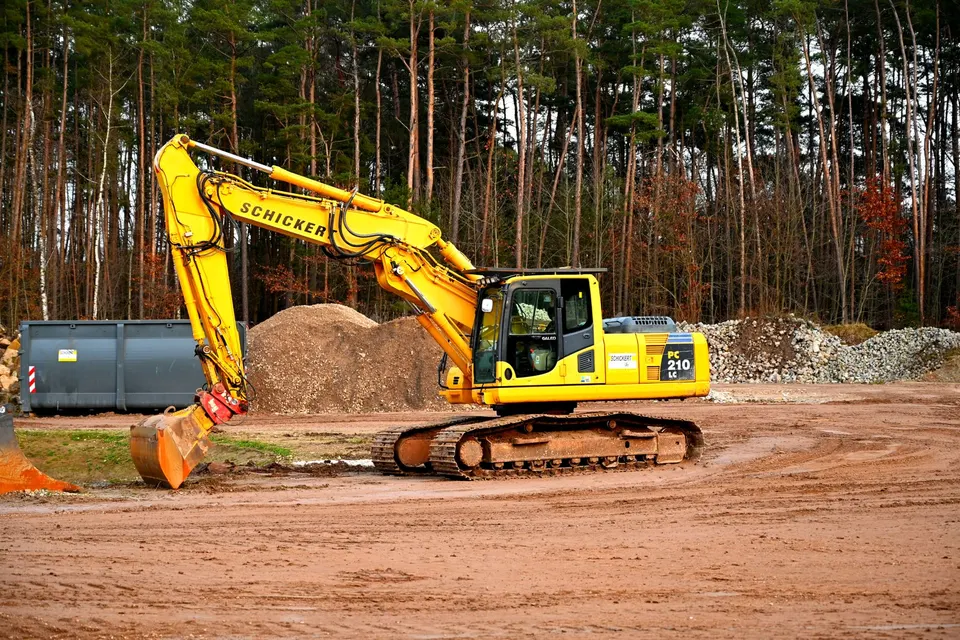
Clearing work is usually done with tracked machines because they spread their weight and can work soft Piedmont clay without tearing it apart the way wheels do. A compact track loader with a root grapple handles a large share of the work, picking up limbs, pulling small stumps and stacking debris. Larger stumps and buried roots typically call for an excavator with a hydraulic thumb, which can pry, lift and shake soil off a root ball before it is moved.
Where stumps sit close to a structure, a well, or a utility line, grinding is often safer than pulling. When debris needs to leave the property, dump trailers or containers come into the picture. The exact mix depends on the job, and we will tell you up front which approach we plan to use and why.
What drives the cost of clearing
We do not post flat prices, because two acres in north Iredell and two acres near Lake Norman can be completely different jobs. Density is the first factor: scattered pines and an open understory go much faster than a tangle of sweetgum, privet and vines. Tree size matters too, since large trunks take longer to fell, cut and move, and their stumps are heavier to pull or grind.
Slope and access come next. Steep ground slows every pass and may limit which machines can safely work it, and a site reached by a narrow gate or a soft field adds time just to get equipment in and out. Finally, the biggest swing usually comes from what happens to the debris. Mulching or piling it on site is generally less involved than loading and hauling it off, and local rules may affect whether burning is even an option. Tell us your preference and we will price the job around it.
Before we start
Have any property lines you are unsure of marked or surveyed. Call NC 811 to have underground utilities located before digging work, which is required by law and free to request. If the land is in a subdivision, check your HOA rules, and if you are near a creek or wetland, be aware that buffer rules may limit what can be cleared. We are happy to talk through what we know, but the property owner is responsible for permits and boundary decisions.
FAQ
Straight answers
Do you remove stumps or just cut trees?
Either, based on what the ground is for. Building pads and driveways usually need stumps pulled out. Pasture or yard areas can often have stumps ground below the surface instead, which disturbs less soil.
What happens to all the trees and brush?
It can be mulched and spread, piled for later, or loaded and hauled away. Hauling adds trucking and disposal time, so it is usually the most involved option. We will lay out the choices when we quote.
Can you clear around the trees I want to keep?
Yes. Selective clearing is common. Mark the keepers with ribbon or point them out in photos, and we will work around their root zones as much as the job allows.
How do I get a price without a site visit?
Text several photos taken from different corners of the property, plus the address or a map pin and a rough idea of size. For many jobs that is enough for a working estimate, and we will say plainly if a walk-through is needed.
Do I need a permit to clear my land?
It depends on your county, the size of the disturbance and nearby water. Larger disturbances can trigger erosion control rules. Check with your county planning office; we can point you to the right questions to ask.
Ready when you are
Send the ground. Get a straight answer.
A few phone photos of the property and a rough idea of what you want it to become is enough to start. We will tell you what it takes, what it will not take, and whether we are the right crew for it.